In an era marked by rising geopolitical tensions, fractured global alliances, and widespread economic fragility, investors worldwide are reassessing their priorities. Traditional financial strongholds—once deemed pillars of stability—are now showing signs of stress. From London to New York, Tokyo to Berlin, markets have become increasingly vulnerable to political upheaval, inflation shocks, and restrictive fiscal policies.
Amid this reshuffling of the global order, one Southeast Asian nation stands resilient, offering a compelling mix of opportunity, security, and long-term potential. That nation is Indonesia.
With over 17,000 islands, a population nearing 280 million, and an economy grounded in rich natural resources and rapid digital transformation, Indonesia is no longer just a developing market—it is a maturing one. For investors seeking stability, consistent returns, and access to resilient real estate markets, Indonesia—and particularly its crown jewel, Bali—is fast emerging as a secure anchor in an otherwise uncertain world.
Navigating a Complex Global Climate: Why Investors Are Turning to the East
The investment landscape in 2025 bears little resemblance to that of just five years ago. The war in Eastern Europe persists, tensions in the South China Sea have intensified, the Middle East remains volatile, and trade and technology disputes between the United States and China continue to ripple through global markets.
Meanwhile, major Western economies face mounting internal challenges: soaring public debt, eroding consumer confidence, and the ripple effects of deglobalisation. Central banks have grown increasingly cautious, inflation proves persistent, and higher interest rates continue to dampen both consumer spending and business investment.
The International Monetary Fund (IMF), in its Global Economic Outlook Report – Spring 2025, cautioned that “global growth is projected to remain below the long-term average for the foreseeable future, as policy fragmentation and geopolitical risks dampen investment sentiment.”
Amid this instability, Indonesia has emerged as a beacon of resilience, quietly weathering the storm and moving strategically towards a prosperous future.
As stated in the World Bank’s Indonesia Economic Prospects Report, Q1 2025:
“Indonesia’s political and security environment continues to provide a bedrock of stability amidst a turbulent world.”
This is no coincidence. It reflects decades of deliberate reform, inclusive development planning, and a national vision built on pragmatism and progress.
Political Stability and Economic Resilience: Indonesia’s Foundations of Trust
In a region often characterised by political unpredictability and macroeconomic volatility, Indonesia has proven itself to be a model of democratic maturity and fiscal discipline.
Its strength lies not merely in its size—as the world’s fourth-most populous country—but in its ability to pair democratic governance with sound economic stewardship. The result is a policy environment that consistently evolves to address domestic needs while remaining welcoming to foreign investors.
Democracy with Direction
Indonesia’s political journey over the past two decades has been one of the great underreported success stories in Asia. Since the fall of authoritarian rule in 1998, the country has undergone a peaceful democratic transition marked by regular free elections, robust civic participation, and an active press.
The 2024 general elections reaffirmed this trajectory. With over 200 million registered voters, the elections were held smoothly, transparently, and with international praise for their integrity. The re-election of a progressive, pro-investment leadership ensured continuity in policy, especially around economic growth, infrastructure development, and digital transformation.
This consistency is no small feat. As geopolitical uncertainties rise, investors are increasingly wary of environments where regime changes bring unpredictable policy overhauls. Indonesia, by contrast, offers policy predictability and national alignment on core economic goals.
“Political stability is no longer a luxury; it’s a necessity for investors. Indonesia offers just that—stability with vision,” says Dr. Suresh Menon, Senior Fellow at the Asia-Pacific Investment Policy Forum, in a May 2025 interview.
 Photo Credit: KPU Indonesia
Strong Macroeconomic Fundamentals
Indonesia’s economic framework has proven not only stable but impressively adaptive. In the first quarter of 2025, the country posted a 5.1% annual GDP growth rate, driven by domestic consumption, a surge in digital services, and a resilient export sector. While many economies struggle with stagflation or contraction, Indonesia remains in expansion mode.
Key drivers of this resilience include:
- Balanced Monetary Policy: The Central Bank of Indonesia has maintained inflation at a manageable 1.95%, well below the regional average. Interest rates have been cautiously adjusted to support both lending and savings.
- Prudent Fiscal Management: The national budget prioritises infrastructure, healthcare, and education, without excessive reliance on debt. Public debt levels remain below 40% of GDP—an impressive statistic compared to many developed nations.
- Robust Foreign Exchange Reserves: With reserves exceeding US$155 billion as of June 2025, Indonesia enjoys ample buffers to weather external shocks.
- Stable Rupiah: The currency has remained relatively stable against the US dollar and major Asian currencies, reflecting confidence in the country’s economic management.
Inclusive and Sustainable Growth
Where some nations pursue growth at the expense of social stability, Indonesia has taken a more balanced path. The government’s policies are designed to lift domestic living standards while attracting international investment, creating a dual-engine growth model.
Through programmes such as:
- The National Affordable Housing Scheme (locally known as the “One Million Homes” initiative),
- Tax incentives for job-creating industries, and
- The Digital Economy Blueprint 2025, which supports tech startups, green industries, and digital infrastructure,
Indonesia is not merely pursuing GDP growth, but growth that is inclusive, digital-first, and future-facing.
This approach has also won praise from global financial institutions. In its latest country assessment, the Asian Development Bank (ADB) noted that “Indonesia is achieving rare equilibrium: it is growing rapidly, managing inflation, and protecting its vulnerable populations through targeted fiscal spending.”
A Reformist Investment Climate
The last five years have seen Indonesia undertake one of its most comprehensive investment reform programs in modern history. By 2025, the country’s policy will have matured into a transparent framework where all sectors are open to foreign investors unless explicitly restricted. And even within restricted sectors, new public-private partnership models and joint venture incentives have made entry easier than ever.
Highlights of Indonesia’s 2025 investment regime:
- Full foreign ownership is permitted in sectors including digital infrastructure, healthcare, education, logistics, and tourism.
- 245 business sectors are prioritised under the Investment Coordinating Board (BKPM), with access to tax holidays and expedited permits.
- Special Economic Zones (SEZs) in Bali, Lombok, Batam, and Kalimantan offer added benefits, including duty exemptions and simplified land use rights.
For real estate investors, these changes mean reduced bureaucracy, greater legal clarity, and a more predictable investment environment.
Rachel Morrow, Southeast Asia Director at the Global Real Assets Fund, remarks:
“Indonesia’s investment liberalisation has outpaced most ASEAN peers. It’s a jurisdiction that finally treats foreign investors not as outsiders, but as partners in growth.”
The Youth Dividend
With over 135 million people under the age of 35, Indonesia boasts one of the world’s most dynamic workforces. This youthful population is not only tech-savvy and entrepreneurial but also hungry for progress. As urbanisation accelerates and purchasing power grows, so too does domestic demand for real estate, tourism, e-commerce, and lifestyle services.
Unlike ageing Western economies struggling to support pension systems and workforce shortages, Indonesia is enjoying its demographic golden era. For long-term investors, this is a critical factor in ensuring steady rental demand, workforce availability, and a growing middle-class customer base.
Real Estate: A Proven Investment in Uncertain Times
As global markets reel from instability, seasoned investors are shifting their focus toward tangible, income-generating assets. Real estate, long regarded as a hedge against inflation and market volatility, is once again in the spotlight—but not just any real estate.
Increasingly, eyes are turning to Indonesia, where property markets offer not only security and legal protection but also impressive yields, tourism synergies, and sustainable long-term growth.
Property as a Global Safe Haven
Historically, property has outperformed many other asset classes during periods of economic uncertainty. While equities may dip and currencies may devalue, well-located real estate tends to retain, or even increase, its value, especially when backed by strong fundamentals.
In 2025, this narrative is more relevant than ever. International investors are actively seeking resilient markets—those with robust demand drivers, legal clarity, and attractive yields. Indonesia, and Bali in particular, fits this profile with growing conviction.
“Amidst uncertain times, real estate provides both income and insulation. Indonesia’s stable trajectory and evolving legal frameworks are making it the region’s most investable real estate market,” says Adrian Lee, Director of Asia-Pacific Research at Knight Frank, June 2025.
Why Indonesia’s Property Sector Remains Safe and Attractive
Unlike overheated Western markets facing saturation, regulatory clampdowns, and declining yields, Indonesia’s real estate market remains in a growth phase, fuelled by demographic expansion, urbanisation, and a post-pandemic tourism boom.
1. Government Support
The Indonesian government actively supports real estate growth through nationwide infrastructure development, regulatory reform, and foreign investment incentives. From expanding airports and roads in key tourism hubs to liberalising property ownership regulations, these initiatives are creating a more accessible, investor-friendly environment across regions like Bali, Lombok, and beyond, driving sustained demand and long-term property value.
2. Economic Enablers
Indonesia’s strong economic performance supports long-term property appreciation. While many developed markets face currency depreciation and declining consumer activity, Indonesia’s internal demand remains strong and resilient.
3. Legal Protection
Law No. 25/2007 guarantees that foreign investments cannot be nationalised or expropriated, providing vital legal certainty for property investors.
4. Tourism Synergy
Indonesia’s real estate market is closely aligned with its tourism industry. With the return of international travel, demand for villas, resorts, and hospitality-linked developments continues to soar.
5. Golden Visas and Global Family Office Engagement
Indonesia is fast emerging as a prime destination for global capital, driven by two powerful initiatives. First, the Golden Visa programme, introduced in September 2023, offers long-term residency—5 or 10 years—based on substantial investments. Individuals who invest USD 2.5 million in a local company qualify for a five‑year permit, while those investing USD 5 million can receive a ten‑year one. Alternatively, smaller investments in government bonds or stocks (USD 350k–700k) also qualify, with around 300 Golden Visas issued so far, bringing in approximately USD 123 million.
Second, Chairman of the National Economic Council of Indonesia Luhut Binsar Pandjaitan has been aggressively courting global family offices and high-net-worth individuals. Notably, he met with Ray Dalio in Bali in September 2024 to discuss opportunities spanning the global economy and Indonesia’s marine biodiversity. He also reached out to elite families like the Porsches, signalling Indonesia’s ambition to sit alongside Singapore as a hub for international wealth management.
Together, these initiatives send a strong message: Indonesia is open for serious, long-term investment. The Golden Visa adds immigration stability, while government-led outreach builds global trust and access to valuable networks and expertise. As a result, Indonesia is being repositioned as a secure, future-focused destination for property investment and private capital.
Foreign Ownership: Secure Legal Pathways
While Indonesia does not allow foreigners to hold freehold land titles (Hak Milik), it offers clear, secure, and renewable legal pathways for foreign property ownership.
These include:
- Hak Sewa (Leasehold): The simplest and most common option, leaseholds typically range from 25–30 years with options for extension. These leases can be bought, sold, or transferred, and are commonly used for villas and commercial properties.
- Hak Guna Bangunan (Right to Build – HGB): This title allows a foreign-owned PT PMA to build and operate properties on land for a period of up to 80 years (initial 30 years, extendable twice). Ideal for commercial ventures and resort developments.
- Hak Pakai (Right to Use): This right grants foreigners permission to use land for residential purposes, particularly when structured under regulated frameworks.
- PT PMA Structure: Establishing a foreign-owned company in Indonesia (PT PMA) allows greater control and flexibility, especially for high-value investments. Through a PT PMA, investors can legally hold HGB titles, open local bank accounts, and access tax efficiencies.
Read also: Leasehold vs Freehold in Bali: Why Long-Term Leaseback in Nusa Penida Wins
Bali: The Beating Heart of Indonesia’s Property Boom
No conversation about property in Indonesia is complete without Bali. More than just a travel destination, Bali has emerged as one of Asia’s highest-yielding luxury property markets, with demand showing no signs of slowing.
In 2025, Bali remains Southeast Asia’s most attractive luxury property market, offering:
- Rental yields of 10–13%, well above the global average of 4–6%.
- Short ROI cycles, with most investors recouping capital within 5–6 years.
- Strong appreciation potential, especially in hotspots like Canggu, Uluwatu, and Seminyak.
- A growing interest in sustainable, eco-conscious developments, driving demand for high-end villas and resort properties.
While Bali and its surrounding islands present exceptional opportunities, it’s important to acknowledge that the real estate market here is still relatively immature compared to more regulated environments like Europe or the United States. This youthfulness creates space for higher returns—often up to 15% in well-positioned, high-performing assets—but it also requires investors to be more hands-on.
With fewer established systems and greater variation in quality and legality of developments, thorough due diligence is not just recommended, but essential. Those who take the time to assess local regulations, verify ownership structures, and work with experienced professionals are best positioned to capitalise on Indonesia’s growth while safeguarding their investment.
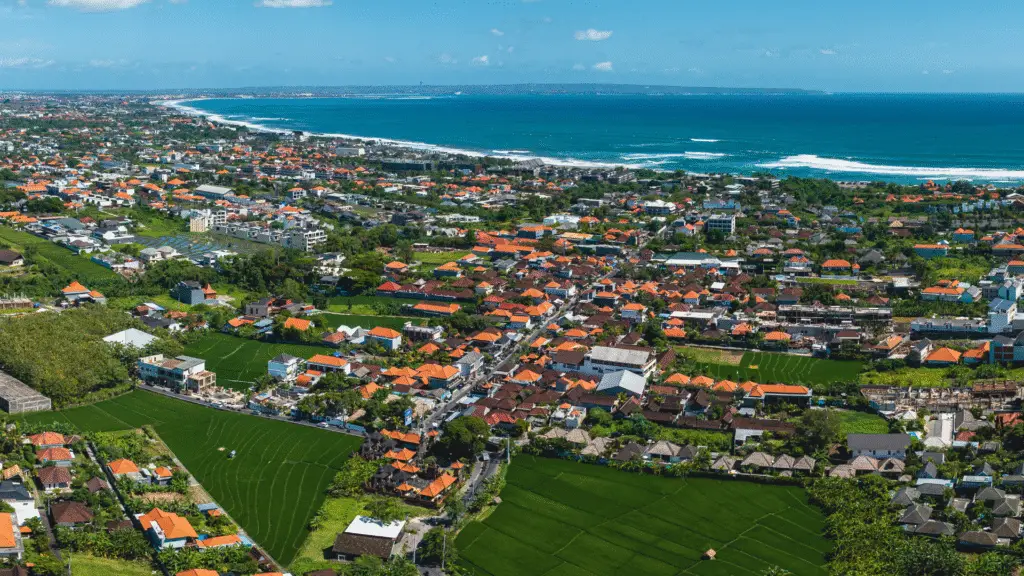 Canggu has rapidly evolved into Bali’s trendiest and most sought-after area, with booming property development, thriving cafés and co-working spaces, and a sharp rise in both local and international investment.
Legal Risk Mitigation and Investor Confidence
While the Indonesian real estate market is a fertile ground for growth, successful investment still requires careful navigation and due diligence.
Key precautions include:
- Title verification: Ensure land has clear, uncontested ownership and is not under dispute.
- Zoning and usage checks: Confirm that the land is zoned for the intended use (residential, commercial, tourism).
- Environmental and cultural compliance: Bali and Nusa Penida have strict environmental and religious site protection laws.
- Road access and utilities: Check for guaranteed access rights, electricity, and water connections.
- Professional partnerships: Engage local notaries, licensed agents, and legal advisors familiar with foreign investment law.
Real Estate as a Long-Term Wealth Builder
What sets Indonesian real estate apart is its ability to serve multiple investor profiles:
- Buy-to-let investors earn high passive income via short-term rental platforms.
- Lifestyle investors gain access to tropical living with portfolio diversification.
- Eco-conscious developers tap into a booming demand for sustainable tourism.
- Capital growth seekers benefit from undervalued land in emerging zones.
 Read also: Nusa Penida: Bali’s Next Investment Frontier
Spotlight: Nusa Penida – Bali’s Next Frontier
Once considered an untouched island paradise, Nusa Penida is now firmly on the investment radar.
Why Nusa Penida is gaining ground in 2025:
- Land prices are still undervalued compared to mainland Bali, offering a first-mover advantage.
- Tourism infrastructure is expanding, with improved ports, transport links, and hotel investments.
- Government-backed zoning supports sustainable, low-density development, favouring long-term value preservation.
- Investor-friendly planning regulations, especially for eco-friendly and culturally sensitive developments.
As investment accelerates across Bali and emerging areas like Nusa Penida, it is essential that growth does not come at the expense of local culture, community well-being, or environmental integrity. Bali’s unique spiritual and cultural heritage is central to its global appeal, and any development must respect and preserve this identity. There is a growing need for eco-conscious, sustainable projects that prioritise low-impact design, responsible land use, and ethical construction practices. Developers who embrace these principles—balancing profit with purpose—will not only earn long-term trust but also play a critical role in shaping a more resilient and respectful future for Indonesia’s most treasured destinations.
Cross Celesta Nusa Penida: Unlocking Fractional Investment Opportunities
Among the standout developments leading this new era of investment in Nusa Penida is Cross Celesta Nusa Penida, a luxury eco-resort concept developed in partnership with CROSS Hotels & Resorts and other visionary collaborators. Seamlessly blending refined hospitality with sustainable design, Cross Celesta Nusa Penida is now offering fractional investment opportunities, enabling international investors to co-own premium resort villas with lower capital outlay and reduced risk. Investors benefit from both asset appreciation and recurring rental income, while also enjoying personal usage rights in one of Indonesia’s most sought-after island destinations.
Ready to explore the opportunity?
👉 Download the Investor Deck to learn more about Cross Celesta’s vision, financial projections, and ownership structure.